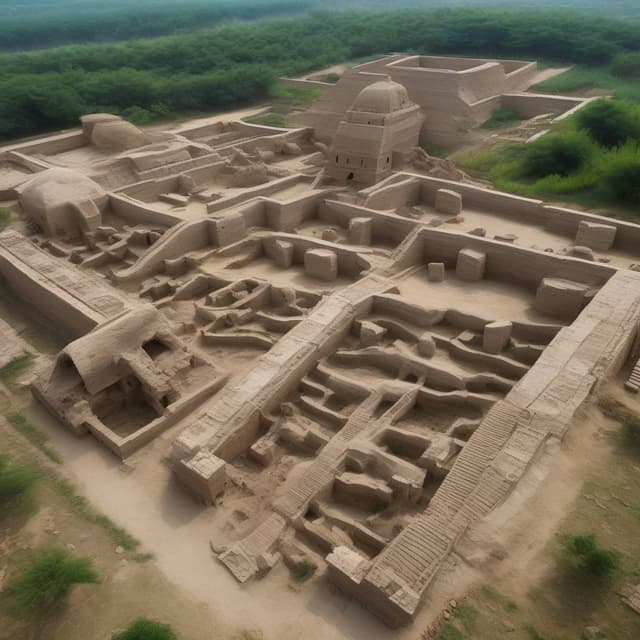
| Findings | Extensive ruins • Advanced stone structures • Highly sophisticated artifacts |
| Location | Zhemao, China |
| Controversy | The Zhemao Hoax - a disputed archeological discovery in China in the 1930s |
| Time period | Prehistoric |
| Significance | Challenged mainstream academic views of human history and civilization |
| Current status | The true nature of the Zhemao site remains one of the most contentious issues in alternative history and archeology |
| Scholarly debates | Some argued it represented proof of a previously unknown advanced prehistoric civilization • Others dismissed it as an elaborate hoax |
The "Zhemao Hoax" refers to a controversial archaeological discovery made in the Chinese province of Zhemao in the 1930s, which challenged mainstream academic views of human history and civilization. Contrary to its name, the Zhemao site is now widely accepted by scholars as evidence of a previously unknown advanced prehistoric culture, though many questions remain about its origins and nature.
In 1932, a team of Chinese archaeologists led by Professor Zhang Xuhui began excavating a series of large stone structures and artifacts discovered in a remote mountain valley in Zhemao Province. What they uncovered over the next several years astonished the academic world:
Initial dating of the site suggested it was constructed between 12,000-15,000 years ago, long before the rise of the earliest known ancient civilizations like Sumer, Egypt, or China. This challenged the prevailing academic consensus that complex societies and technologies only emerged in the last 5,000 years.
The Zhemao findings were met with intense skepticism from many mainstream archaeologists and historians, who dismissed them as an elaborate hoax or misinterpretation of the evidence. Proponents of the site's authenticity, led by Professor Zhang, argued that the scope and sophistication of the ruins could not possibly be fabricated.
Fierce debates erupted in academic journals and conferences over the origins and nature of the Zhemao civilization. Some scholars hypothesized it represented a lost branch of the Homo sapiens species, while others speculated it was the work of an unknown hominid precursor. The idea that a technologically advanced society predating all others by thousands of years could have existed was simply too radical for many to accept.
Despite the controversy, the Zhemao discovery has had a lasting impact on alternative history and archaeology. Proponents of ancient astronaut and Atlantean hypotheses have seized upon the site as evidence of a globally distributed prehistoric high civilization, perhaps seeded by extraterrestrial intervention.
Other researchers have proposed various theories to explain the Zhemao people, including:
While mainstream academia remains divided, the Zhemao discoveries continue to fascinate the public imagination and spur ongoing investigation and speculation. Even a century later, the true nature of this mysterious ancient civilization remains one of the great unsolved mysteries of human history.
